
Unusual / Position Guide
The CrossSex Position
You are not doing this one for the eye contact.
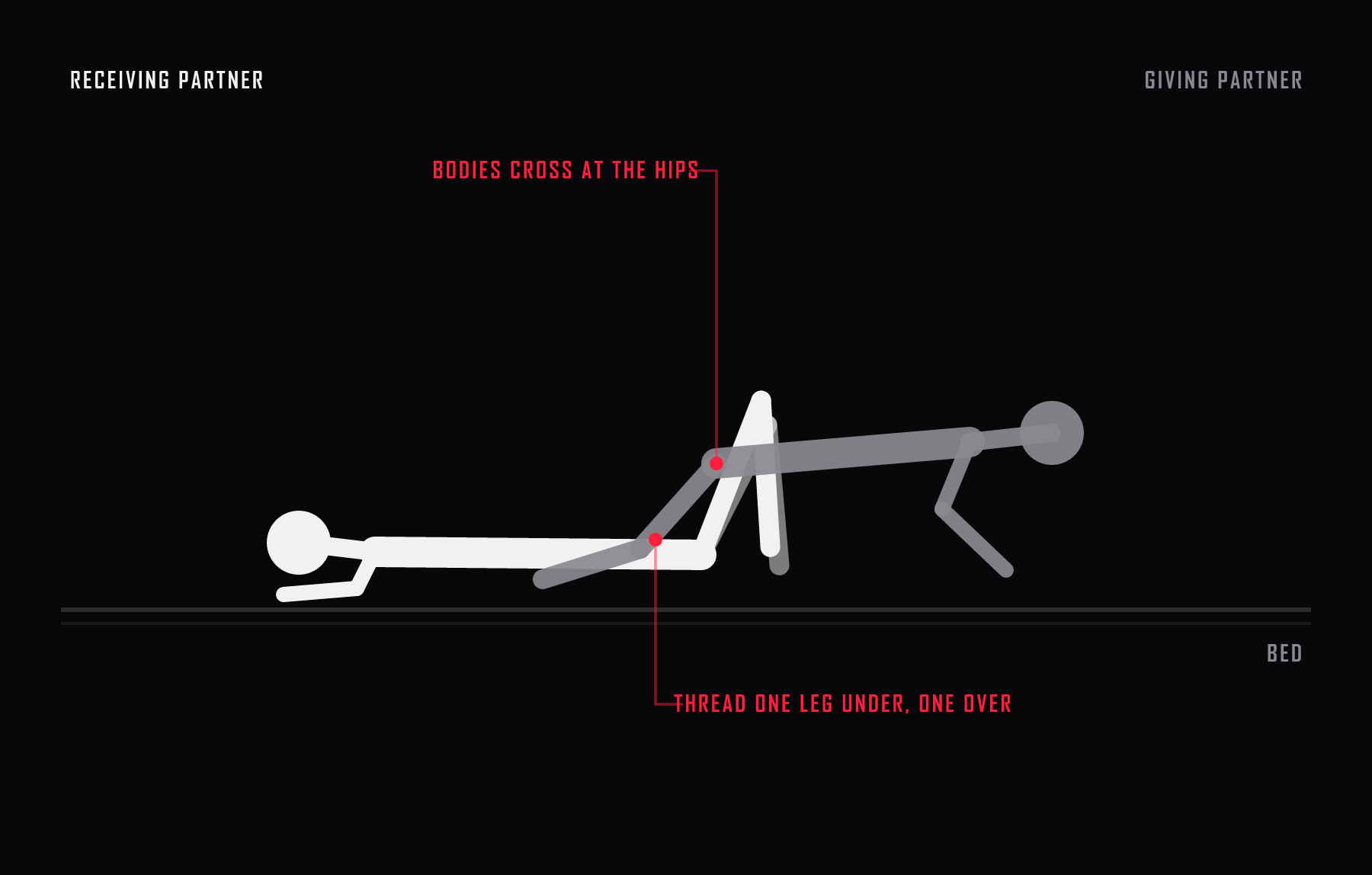
The cross has the receiving partner on their back and the giving partner on their side, lying perpendicular, with the legs interlocked so the two bodies form a rough X. It takes a minute to set up, it is not especially close, and conversation is awkward because nobody is facing anybody.
It is worth learning anyway, for exactly one reason. Every other position on this site puts two bodies in line with each other and varies the tilt. This one comes in from the side, and lateral pressure is a different sensation rather than a smaller or larger version of the usual one.
What TheCross Is
The receiving partner lies on their back with the knees bent and the legs slightly apart. The giving partner lies on their side, body running crosswise, with their hips brought in underneath and their legs threaded through, usually one leg under and one over.
From above the two bodies make an X, which is where the name comes from. Neither person is on top of the other, so nobody is carrying weight and nobody is holding themselves up.
It sits in the odd corner of most lists of position guides, and it deserves better than the novelty label it usually gets. It is one of very few positions that changes the direction of pressure rather than the amount.
Why SidewaysFeels Different
In an in-line position, adjusting means changing the tilt. Steeper, shallower, deeper, less deep. The direction stays broadly the same and every position on this site is a variation on how much.
Coming in perpendicular changes the direction instead. Pressure lands against one side rather than front or back, and it is a genuinely distinct sensation rather than a rearrangement of a familiar one. People who describe it as feeling wrong on the first attempt and then coming back to it are usually reacting to that unfamiliarity.
Which side you approach from also matters. The two mirror images of this position are not the same, and couples set it up once, form an opinion, and never try the other side. That is worth knowing before you decide. Side saddle has the same handedness for the same reason.
How deep is the interlock?
Slide it to see how threading the legs changes the angle. Closer hips mean more of the lateral pressure the position exists for.
How To ActuallyDo It
- 1
Decide which side first
The two mirror images feel different. Pick one deliberately rather than falling into whichever happened first.
- 2
Receiving partner on their back, knees bent
Knees bent and slightly apart. Straight legs make threading the interlock much harder than it needs to be.
- 3
Come in from the side
The giving partner lies on their side, body crosswise, and brings their hips in underneath rather than approaching from above.
- 4
Thread the legs
One leg under, one over. Take the time to get this comfortable, because a bad interlock is the reason this position gets abandoned.
- 5
Close the gap at the hips
Everything depends on how close the hips get. Most of the fiddling is about that and none of it is about the upper bodies.
ComfortAnd The Interlock
The legs are the awkward part. A badly threaded interlock puts a knee somewhere unwelcome and makes the whole position feel like a puzzle that is not worth solving. Spend the extra fifteen seconds getting it right rather than starting and hoping it settles.
Because nobody is on top, nothing bears weight and nothing is under strain. That makes this a surprisingly restful position once it is set up, and it can run much longer than its fiddly reputation suggests.
The lateral angle is unfamiliar and can feel abrupt at first, so start slow and shallow. Lube helps, and so does the receiving partner raising their top knee, which opens the angle and takes the edge off the first minute.
VersionsWorth Trying
The receiving partner raising the top knee toward their chest opens the angle considerably and lets the hips get closer. It is the adjustment that turns a fiddly setup into a working position.
A pillow under the receiving partner's hip tilts the pelvis and adds depth without changing the perpendicular approach that the position exists for.
Approaching from the other side is a different position in practice, and it is the one thing most couples never try. For a lateral angle where the receiving partner is on top and in control, side saddle gets there from the opposite direction.
What is your cross tonight?
Tap the mood.
WhoIt Is Best For
This suits couples who have run out of variations on the usual angle and want something structurally different rather than incrementally deeper. It is also a good fit for long sessions, since nothing bears weight once it is set up.
It is a poor fit when closeness is the point, because you cannot see each other properly and talking is awkward. The setup will also defeat some couples, and if the interlock does not become comfortable after a couple of tries, the position is probably not worth forcing. The scissor is the simpler interlock to try instead, with the legs opened like scissors and the hips meeting in the middle for a grind.
What GoesWrong
Settling for a bad leg interlock
A knee in the wrong place is the most common complaint about this position, and it is entirely preventable. Take the time over the thread rather than starting from an interlock you are already working around.
Starting straight-legged
Knees bent and slightly apart. Straight legs make the angle harder to reach and the interlock harder to build.
Not closing the gap at the hips
Everything here depends on how close the hips get, and most of the fiddling is about that rather than the legs. It is worth solving before any movement starts.
Questions PeopleAsk
What is the cross sex position?
The receiving partner lies on their back and the giving partner lies on their side, perpendicular to them, with the legs interlocked so the bodies form a rough X shape. Neither person is on top, so nothing bears weight.
Why does the cross position feel different?
Because it changes the direction of pressure rather than the amount. Almost every other position puts two bodies in line and varies the tilt. Coming in from the side produces lateral pressure, which is a distinct sensation rather than a deeper or shallower version of the usual one.
Why is the cross position so hard to set up?
The leg interlock. One leg goes under and one over, and getting it comfortable takes longer than it looks. Bending the receiving partner's knees before threading makes it considerably easier.
Does it matter which side you approach from?
Yes. The two mirror images of this position are not the same and they feel different. Most couples set it up once and never try the other side, which is worth doing before forming a verdict.
How do you get deeper in the cross position?
Close the gap at the hips, which is where all the depth comes from, and have the receiving partner raise their top knee toward their chest. A pillow under their hip adds tilt without changing the perpendicular approach.