Closeness / Position Guide
Bear HugSex Position
Every other page here tells the partner on top to carry their own weight. This is the exception.
The bear hug has the receiving partner lying face down, or rolled slightly onto one side, with the giving partner covering them from behind and both arms wrapped right around. Legs follow, and very little happens after that. Movement is small and depth is modest.
What earns it a page is that it reverses the advice on every other guide here. Elsewhere the partner on top is told to keep their weight on their forearms, because weight is a thing to manage. Here the weight is the point, and taking it off removes exactly what you came for.
What TheBear Hug Is
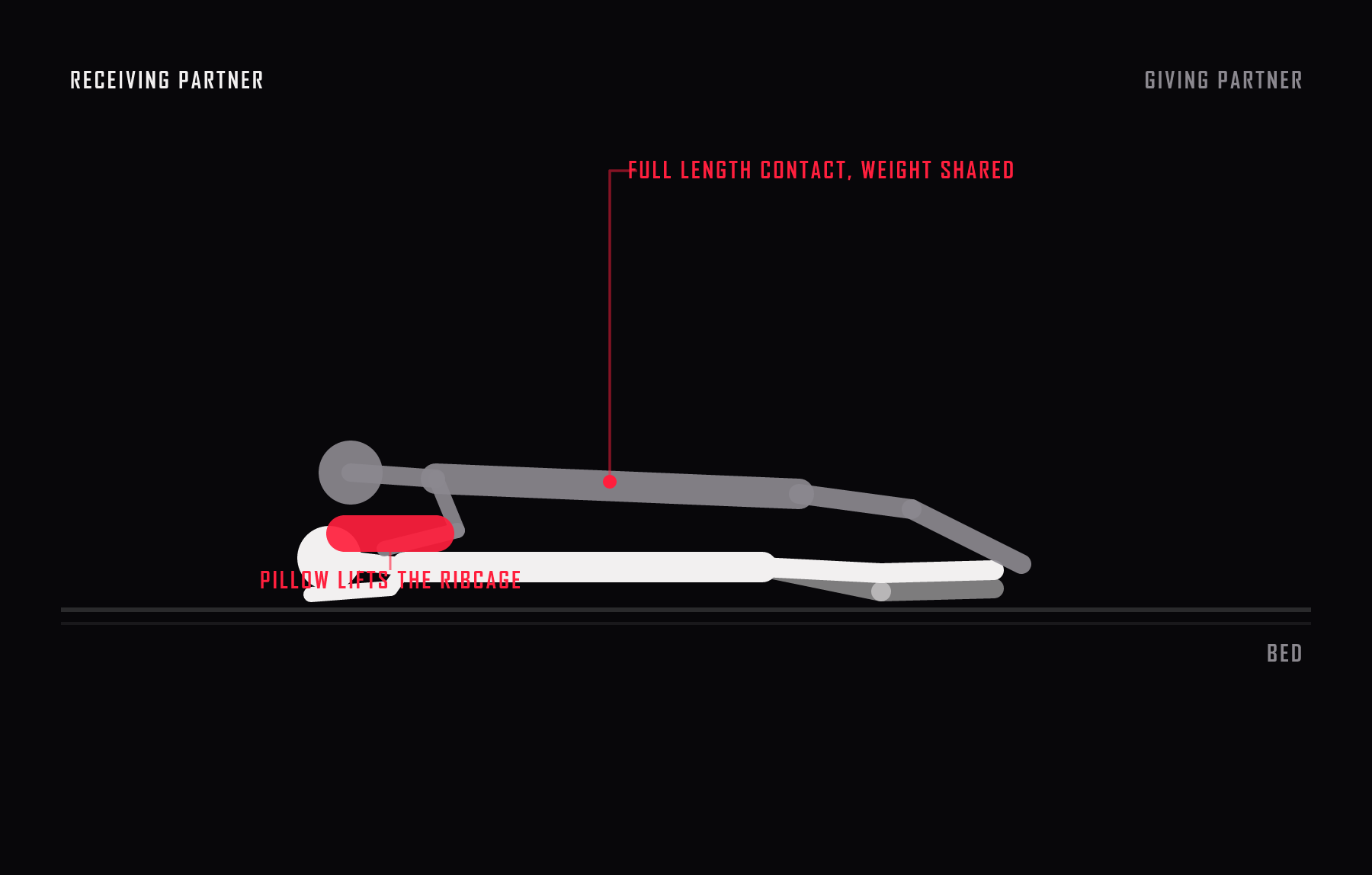
The receiving partner lies flat on their front, or turned a little onto one side. The giving partner lies along the full length of their back and wraps both arms around the chest or under the shoulders, so the hold is around the body rather than propped beside it.
The angle is shallow. Flat bodies and closed legs shorten the reach considerably, which would be a complaint on most pages and is not one here. Depth is not the product.
It sits quietly among the closeness entries on lists of position guides and gets passed over for not doing anything impressive. That is fair, and a bad reason to skip it.
Why PressureRather Than Motion
Broad, even pressure across the whole body is calming in a way that has nothing to do with technique, which is the same reason a heavy blanket feels good. Being covered and held produces a specific kind of settling, and this position delivers that rather than an angle.
Because the sensation comes from the wrap rather than the movement, small is better. Big movements break the contact and trade the thing that works for a shallow version of something available elsewhere. The flat iron is the deliberately shallow position next door, and this is its slower cousin.
The caveat belongs here rather than at the bottom. Weight has a limit, it differs for everybody, and it moves depending on the night. A large size difference changes the calculation entirely. None of that argues against the position, and all of it argues for asking out loud.
How much weight is actually on?
Slide it from barely resting to fully committed. The right answer is a conversation, not a number.
How To ActuallyDo It
- 1
Get flat and comfortable first
The receiving partner settles face down, head turned to one side, pillow wherever it helps. Sorting this now avoids shuffling once somebody is on top.
- 2
Lie along the whole back
Full length contact rather than propped up on the elbows beside them. The contact along the body is the position.
- 3
Wrap the arms properly
Around the chest or under the shoulders rather than planted on the mattress. Planted arms make this an ordinary flat position.
- 4
Ask about the weight out loud
Once, early, plainly. Weight is the one variable here, and it cannot be judged from the top.
- 5
Keep the movement small
Small movements preserve the contact. Large ones break it and swap the good part for a shallow version of something else.
ComfortAnd Breathing
Breathing is the real limit, and worth naming directly. Weight on the upper back presses the chest into the mattress, and that goes from cosy to uncomfortable without much warning. If the receiving partner is working to breathe, there is too much on, and that is not something to be stoic about.
A pillow under the chest is the simplest fix, lifting the ribcage enough to leave the breathing easy while keeping the pressure everywhere else. With a large size difference, the partner on top can take a share through their knees and elbows and keep the wrap intact.
The head stays turned to one side, so swap which way every so often to keep the neck happy. The pace is slow and the angle shallow, so friction rather than depth sets the limit, and lube matters more than the gentle description suggests.
VersionsWorth Trying
Both partners on their sides with the giving partner wrapped around from behind is the same idea without the weight question. It is spooning with the arms committed, for nights when full weight is not wanted.
A pillow under the receiving partner's hips lifts them into a usable angle without changing the hold, which is the fix if shallow is too shallow. With that pillow in place, trading the wrap for hands linked overhead and slow circles turns it into the dragon.
The face to face version has both partners on their sides, legs interlocked, wrapped around each other. It trades the covered feeling for eye contact, and kneeling is the upright position with the same appeal.
What is your bear hug tonight?
Tap the mood.
WhoIt Is Best For
This suits couples who want to be held more than an angle, and it is a good answer on tired or difficult evenings where closeness is the actual request. Being fully covered settles some people in a way nothing else here does.
It is a poor fit if being enclosed feels confining rather than calming, which is a real reaction worth respecting. A large size difference needs the supported version. If depth is what you want, this is the wrong page, and doggy style is two clicks away.
What GoesWrong
Judging the weight instead of asking about it
Weight is the one variable that decides this position, and it cannot be read accurately from on top. Ask once, early, and plainly, rather than guessing from how still the person underneath is being.
Propping up on the elbows
Holding yourself off breaks the full length contact that the whole position is built on. If the weight needs sharing, take it through the knees and elbows while staying in contact rather than lifting away.
Moving too much
Pressure rather than motion is the mechanism. Large movements break the contact and turn it into an awkward version of something else, while small ones keep it intact.
Questions PeopleAsk
What is the bear hug sex position?
The receiving partner lies face down or slightly on one side and the giving partner lies along their full back with both arms wrapped around them. Movement is small and the angle shallow, since the appeal is full body contact rather than depth.
Is the bear hug position meant to feel heavy?
Yes, and that is the point of it. Almost every other position asks the partner on top to carry their own weight. Here the weight and the wrap are what the position is for, so taking it off removes the reason to choose it.
How do you stop the bear hug being too heavy?
Put a pillow under the receiving partner's chest, which lifts the ribcage and keeps the breathing easy while the pressure stays everywhere else. The partner on top can also take a share through their knees and elbows without letting go.
Is the bear hug position deep?
No. Flat bodies and closed legs make the reach short, and the shallow angle is a side effect of the shape rather than a flaw. A pillow under the hips lifts the angle if more depth is wanted.
Does a size difference rule out the bear hug?
Not usually, but it changes how you do it. The larger partner takes some weight through their knees and elbows while keeping the arms wrapped, and the pillow under the chest matters more. If breathing is affected at all, there is too much on.