
Face To Face / Position Guide
KneelingSex Position
Modest depth, total contact, and your knees decide when it ends.
Kneeling has both partners upright on their knees, facing each other, thighs meeting and chests together. Depth is modest and the range of movement is small. Judged on the things positions are normally judged on, it does not score especially well.
It is on this site because it optimises for something else entirely. More of you is touching more of them than in any other position here, both sets of arms are completely free, and your faces are at the same height. It is closer to an embrace that happens to involve sex than a technique.
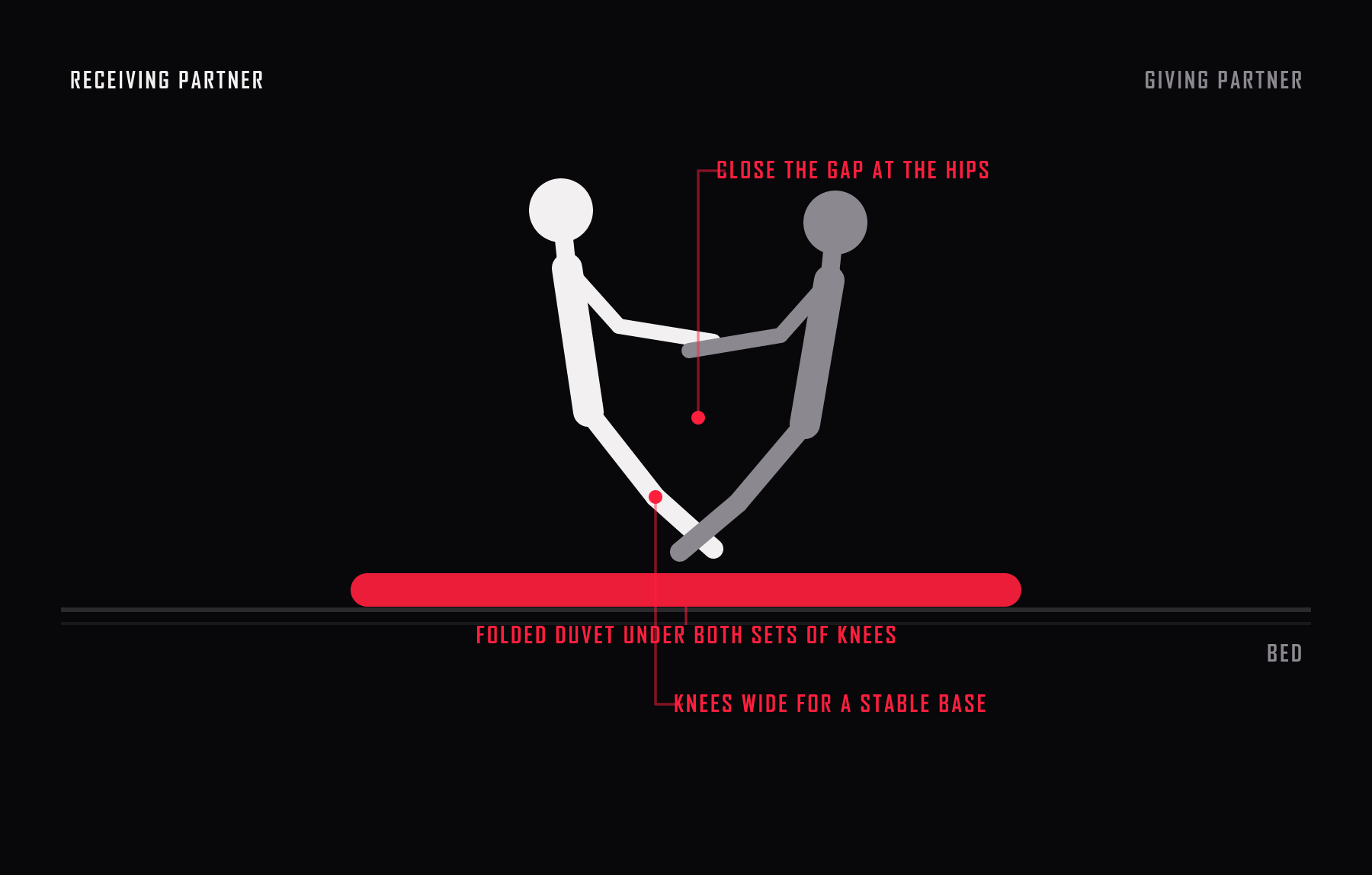
What KneelingIs
Both partners kneel facing each other, knees apart for stability, hips brought together. One partner usually sits back slightly onto their heels while the other stays more upright, which is how the heights end up working.
The movement is small and comes from both sets of hips rocking rather than either person thrusting. There is no leverage here and trying to manufacture some is what makes people fall over.
It occupies the quiet middle of most lists of position guides. Nothing about it is impressive on paper, which is exactly why it gets skipped by people who would like it.
Height Is NotFixable Here
In standing positions a height mismatch is solved with a step or a counter. Kneeling has no such option, because both people are already at a height set by the length of their own thighs. There is nothing to stand on.
So the adjustment has to come from the bodies. One partner sitting back onto their heels drops them several inches instantly, and that alone resolves most mismatches. If it is not enough, a firm cushion under the knees of whoever is shorter lifts them back up.
If the gap is large, the taller partner can widen their knees considerably, which lowers them without changing anything else. Between those three there is usually an answer, and if there is not, this position may simply not suit the two of you, which is a normal outcome rather than a failure of effort.
How upright are you both?
Slide it to see how sitting back changes height and effort. Upright is closest, sitting back lasts longer.
How To ActuallyDo It
- 1
Kneel facing each other, knees apart
A wide base is what keeps this stable. Knees together plus any movement is how couples end up sideways on the mattress.
- 2
Sort the height first
One of you sits back onto the heels. Decide this before you start rather than shuffling once you are already close.
- 3
Bring the hips together
Close the gap at the hips rather than leaning in from the chest. Leaning from the chest just tips you both forward.
- 4
Use your arms
Both of you have both hands free, which is unique here. Hold on to each other properly and it doubles as the stability solution.
- 5
Rock, do not thrust
There is no leverage in this position. Small movements from both sets of hips work. Anything bigger just costs you your balance.
ComfortAnd Your Knees
Knees end this position, every time, and they do it sooner on a firm surface. A folded duvet, a thick blanket or a pillow under both sets of knees is the single change that turns kneeling from a five minute novelty into something you would choose.
Ankles are the second complaint, particularly for whoever is sitting back on their heels. If the ankles object to that position, staying more upright is the fix, and then the other partner sits back instead.
Depth is modest and the movement is small, so friction rather than depth is what eventually ends things. Lube matters here for a long session, and the slow pace means it builds gradually rather than arriving early.
VersionsWorth Trying
The receiving partner sitting back on their heels while the giving partner stays upright and leans in is the most common working arrangement, and it hands most of the movement to one side.
Both partners kneeling upright and holding on to each other is the maximum contact version. It has almost no leverage, which is fine, because leverage is not what anyone came here for.
One partner kneeling with the other seated on the edge of a bed changes the heights entirely and adds back some range. For a face to face position where nobody kneels on anything, sideways gets the same closeness lying down.
What is your kneeling position tonight?
Tap the mood.
WhoIt Is Best For
This suits couples who want contact more than they want angle, and it is a natural fit for slow evenings where the point is being close rather than getting anywhere in particular. Having all four hands free makes it unusually good for everything that is not the position itself.
It is a poor fit for anyone with knee trouble, and padding only postpones that rather than solving it. It also offers very little depth or pace, so it works better as part of an evening than as the whole of one. Large height differences may resist every fix, and that is worth accepting rather than fighting. For the same wrapped-up closeness with no weight on the knees, the lotus has one partner sit cross-legged with the other in their lap.
What GoesWrong
Kneeling with the knees together
A wide base is what keeps this stable. Knees together removes the base entirely, and with no leverage available there is nothing to recover with.
Leaving the height problem until you are in it
One of you sits back onto the heels, and which one is a decision to make before you start. Height is not adjustable mid-position here the way it is elsewhere.
Thrusting rather than rocking
There is no leverage in this position and pushing for some is how people end up off balance. Small movements from both sets of hips is the whole mechanism.
Questions PeopleAsk
What is the kneeling sex position?
Both partners kneel upright facing each other with their thighs meeting and their chests together. Depth is modest and movement is small, but it offers more full body contact than any other face to face position.
How do you fix a height difference when kneeling?
One partner sits back onto their heels, which drops them several inches instantly. If that is not enough, put a firm cushion under the shorter partner's knees, or have the taller partner widen their knees to lower themselves.
Why does the kneeling position hurt my knees?
Because both people are resting their full weight on their kneecaps, usually on a mattress that is firmer than it feels. A folded duvet or thick blanket under both sets of knees is what makes the position last.
Is the kneeling position deep?
No. There is very little leverage and the range of movement is small, so it is a shallow position by nature. It is chosen for closeness and free hands rather than depth.
How do you keep your balance in the kneeling position?
Keep the knees wide apart for a stable base, hold on to each other, and rock rather than thrust. Most balance problems come from trying to generate leverage that this position does not have.