
Three People / Position Guide
Eiffel TowerPosition
The mechanics take a minute to learn. The conversation is the part that takes work.
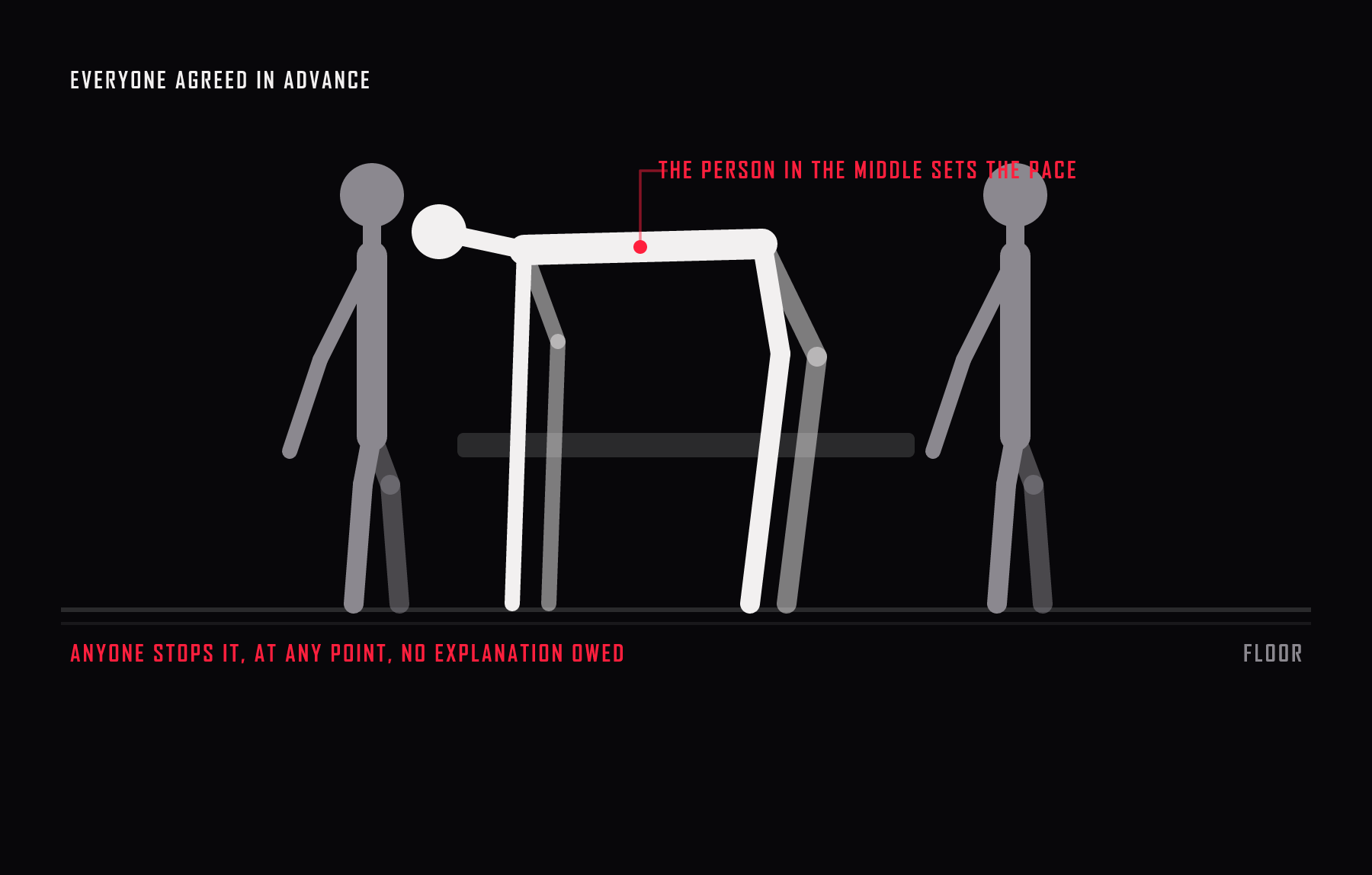
The Eiffel tower is a three person position. One person is on hands and knees in the middle, one is behind them, one is in front, and the two on the outside meet in a high five over the top. That gesture is where the name comes from and it is the entire reason the position is famous.
Physically it is one of the easier things on this site. Nothing is held, nothing is lifted, nobody needs to be flexible. The difficulty is entirely social, and pretending otherwise is how these evenings go wrong. This guide spends most of its time there, because that is where the work is.
What The EiffelTower Is
The person in the middle is on hands and knees. One partner kneels or stands behind them, one kneels or stands in front. The two outside partners face each other and can reach across the top, which is where the high five comes in.
Mechanically it is two familiar positions happening at once, and neither of them is difficult. If you can do doggy style, you can do the physical half of this without any instruction at all.
It appears on lists of position guides as a novelty, which undersells what actually determines whether it goes well. Three people have to agree in advance and keep checking during. That is the position.
The AgreementIs The Position
Have the conversation before anyone takes their clothes off, and have it sober. Who is comfortable with what, what is off the table, whether the two outside partners are touching each other, and what happens if one person wants to stop. Every one of those is easier to answer in a kitchen than in a bedroom.
Agree a way to stop that does not require a speech. Any of the three can end it, immediately, without justifying it, and the evening does not become a negotiation about why. If that rule feels awkward to agree to, that is worth paying attention to rather than talking past.
The person in the middle is a participant, not scenery. They should be able to see and hear both partners, they get checked in with, and their comfort sets the pace for everyone. A position where one person becomes a prop is a bad evening regardless of how it looked in your head. Talking about sex is the underlying skill here.
How much has been agreed?
Slide it from nothing discussed to fully agreed. The right hand side is the only place this works.
How To ActuallyDo It
- 1
Talk it through beforehand
Sober, clothed, and well before the night itself. Limits, what the two outside partners are and are not doing, and how it ends.
- 2
Agree how anyone stops it
Any of the three, at any point, with no explanation owed and no fallout afterwards. Agree this out loud rather than assuming it.
- 3
Set the height
The person in the middle on a bed with the other two standing usually lines everyone up better than all three on the floor.
- 4
Check in with the middle
Not a running commentary. Short, real questions, and enough space for the answer to be no.
- 5
Change position before anyone is uncomfortable
Knees, wrists and jaws all tire here. Moving on early is better than pushing to the point where someone is enduring it.
ComfortAnd Checking In
The person in the middle carries the physical load, on their wrists and knees and often their neck. Cushions under the knees and the option to drop to the forearms both help. Their comfort is the practical limit on how long this lasts.
Height is the logistical problem, since three people rarely line up on a flat floor. Putting the middle person on a bed with the other two standing solves more than anyone expects.
Check in during, not only before. People agree to things in advance and change their mind halfway through, which is normal and allowed. A position where changing your mind is difficult is a position that needs a better plan rather than a braver participant.
VersionsWorth Trying
The two outside partners not touching each other at all is a common and completely reasonable arrangement. Agree it beforehand rather than discovering the assumption mid position.
The middle person up on their forearms rather than their hands takes the load off the wrists and changes the angles for everyone. It is the more comfortable version by a distance.
Any of the three roles can be filled by anyone, and the position does not require a particular combination of people. For the two person version of the same rear entry angle, doggy style covers the mechanics in detail.
What does your group need most?
Tap the mood.
WhoIt Is Best For
This suits groups who already talk easily about sex and have done the boring parts of the conversation properly. If three people can discuss limits without it becoming tense, the physical side of this is genuinely straightforward.
It is a poor fit anywhere someone is being talked into it, and that includes subtle pressure and going along with it to avoid a scene. Enthusiasm from all three is the requirement rather than the ideal. If any one of you is unsure, the answer is not yet, and that answer costs nothing.
What GoesWrong
Treating the person in the middle as a fixture
They are a participant, not a prop. Checking in during rather than only beforehand is the difference between this working and it being something one person endures politely.
Agreeing to it in the moment
The conversation happens sober, clothed, and well before the night itself. Anything agreed halfway through an evening was not really agreed, and nobody should be talked into this.
Not changing condoms between partners
Barrier protection and a change between partners is how infections do not get passed around a group. It is the least interesting part of the setup and the least optional.
Questions PeopleAsk
What is the Eiffel tower position?
It is a three person position where one partner is on hands and knees in the middle, one is behind and one is in front, and the two outside partners meet in a high five over the top. The gesture is where the name comes from.
What should you agree before trying the Eiffel tower?
Limits for all three people, whether the two outside partners are touching each other, and how anyone stops it. Agree that any of the three can end it instantly with no explanation owed. Have that conversation sober and in advance.
Is the Eiffel tower position difficult?
Physically it is one of the easier positions, since nothing is lifted or held and no flexibility is needed. The difficulty is social rather than athletic, which is why the conversation beforehand matters far more than the technique.
How do you make the Eiffel tower comfortable for the person in the middle?
Put cushions under their knees and let them rest on their forearms rather than their hands. Their comfort sets the pace, so check in during rather than assuming the arrangement agreed earlier still stands.
How do you handle three people being different heights?
Put the person in the middle on a bed or a lower surface with the other two standing. Lining three people up on a flat floor is the most common reason this feels awkward, and it is a furniture problem rather than a people problem.