
Side-Lying / Position Guide
T-BoneSex Position
Two bodies at a right angle, and almost no upper body work.
The T-Bone is what happens when someone decides that holding yourself up is overrated. The receiving partner lies on their side. The other partner kneels facing them, coming in from the side so the two bodies make a rough letter T. Nobody supports their own weight for long. Nobody has to plank. It is one of the laziest genuinely good positions in circulation, and the angle is unusual enough to stay interesting.
The shape looks strange written down and makes sense in about four seconds once you are in it. Depth is easy to adjust by moving one leg. Nothing burns out, so the position lasts as long as you want it to. That is rarer than it sounds.
WhatThe T-Bone Is
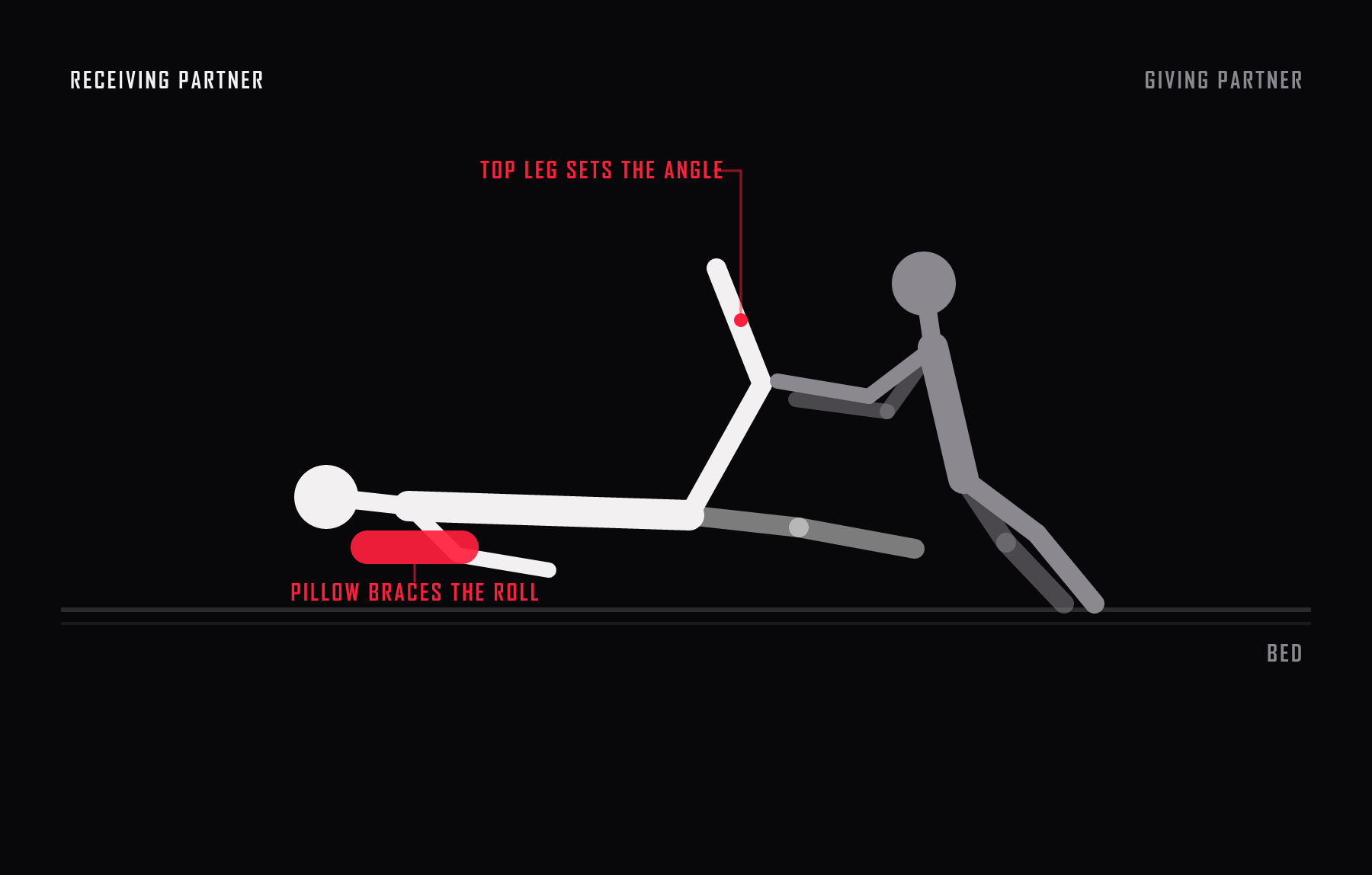
The receiving partner lies on one side. The other partner kneels facing them, coming in perpendicular, so the two bodies form a rough letter T. That is the whole shape. It reads oddly on paper and feels completely normal in practice.
The top leg lifts or bends to open the angle. The kneeling partner straddles the receiver's lower leg. Nobody is doing a push-up. Nobody is balancing on one arm. That is most of the appeal right there.
Pick a side before you begin. The bottom arm of the receiving partner needs somewhere to go, and stretched up past the head is the answer for most people. Tucked under the ribs it goes dead within a minute. The top arm stays free and can rest on the thigh above, which doubles as a speed control.
Why The AngleIs Odd
Coming in sideways changes the direction of the pressure. Instead of running front to back, the angle runs across, which lands differently for a lot of people. Depth stays moderate. Control sits with the kneeling partner.
The side-lying setup also keeps things stable. Rolling is the only real risk, and a pillow behind the receiver's back solves it. If you like this general family of angles, the prone bone is its flatter cousin.
The kneeling partner keeps both hands, which is unusual for a position with this much control. One hand on the hip steadies everything. The other has no job at all, so it is worth giving it one.
How Much Angle Do You Want?
Slide to move the top leg. Everything about the T-Bone follows from where that leg ends up.
How To ActuallyDo It
- 1
Lie On Your Side
The receiving partner lies on either side with the bottom leg straight. A pillow under the head keeps the neck happy.
- 2
Kneel Across
The other partner kneels facing them at a right angle. Straddle the bottom leg so your knees land on either side of it.
- 3
Sort The Top Leg
Bend or lift the top leg until the angle feels right. Start shallow and work up from there.
- 4
Brace The Back
Slide a pillow behind the receiver so they are not fighting the roll. This one fix makes the position last twice as long.
- 5
Find The Rhythm
Move slowly at first, because the sideways angle takes a moment to read. Ask what feels better before committing to a pace.
SettingUp The Legs
Leg position is the only real adjustment here. The bottom leg stays straight. The top leg has options. It can rest forward on the bed for a shallow angle, or hook over the partner's hip for a deeper one. Wrap it right around the kneeling partner's waist and let the upper body twist partway onto the back, and you are in the pretzel. Each choice moves the depth by a surprising amount.
Height matters too. The kneeling partner is often sitting slightly too high, and a folded blanket under the knees fixes it. Slow angles run long, so keep lubricant in reach and reapply early.
Small height errors show up as a wrong angle rather than as discomfort, so they slip by unnoticed. If depth feels shallow and contact sits too high, the kneeling partner is probably riding too tall. Sit back toward the heels an inch before deciding the leg setup is wrong.
Foot placement on the receiving side is a hidden lever. Flexing the bottom foot and pressing the heel into the bed locks the pelvis in place. Letting it go soft lets the hips roll with each movement. Firm gives you control. Soft gives you range.
VariationsTo Steal
Swap the kneel for a squat. The partner squats over the lower leg instead of kneeling, which raises the angle and adds range. It also costs real energy, so save it for a burst.
Add a wedge. A firm pillow under the receiver's hip tilts the pelvis and opens the angle without anyone moving. This is the version most people end up preferring.
Slow it down and it fits neatly into a slow and close night. Push it and it sits closer to the more adventurous positions people try once for the story. It is flexible that way.
Rolling into spooning is the smoothest exit available. The kneeling partner lies down behind the receiving partner and both settle onto their sides. Nothing has to come apart. It is a decent way to end a long session without a hard stop.
What is your energy level tonight?
Tap the mood.
WhoThe T-Bone Suits
This one is for tired people with good intentions. If neither of you wants to hold a plank, the T-Bone delivers. It is also friendly to size differences, because height is easy to fix with pillows.
It suits longer sessions well, since nothing burns out. Anyone working on pacing and stamina will find the moderate depth easier to manage. If you want more drama than that, there is plenty of it elsewhere.
Talking is easy here, which not every position can claim. Faces sit far apart but nobody has a mouth in a pillow. Short direction works best. 'Higher' or 'slower' lands better than a full sentence.
It is a weaker pick when either person wants full body contact. Above the waist only the hands meet. If closeness is the goal tonight, the shape of this one will fight you.
What GoesWrong
Not bracing the roll
A pillow behind the receiver stops them spending the whole position fighting the tendency to roll. It is the single adjustment that turns this from awkward into a long haul position.
Reading the angle at speed
The sideways angle takes a moment to interpret and can feel sharp if rushed. Slowly at first, then build once both people have the measure of it.
Ignoring the kneeling partner
Almost every note about this position is about the receiver, but the kneeling partner is on their knees on whatever surface you chose. On anything firm that becomes the limit.
Questions PeopleAsk
What is the T-Bone sex position?
The T-Bone sex position has the receiving partner lying on their side while the other partner kneels perpendicular to them. The two bodies form a rough letter T. It is a side-lying position that needs almost no upper body strength.
Is the T-Bone position hard to do?
No. It is one of the easier positions to hold, because both partners stay supported. The only tricky part is lining up the first time.
What is the difference between the T-Bone and prone bone?
The T-Bone has the receiver on their side with the partner kneeling across them. The prone bone has the receiver flat on their stomach with the partner lying on top. One is a right angle, the other is fully stacked.
How do you make the T-Bone deeper?
Move the top leg. Lifting it toward the chest or hooking it over the partner's hip both add depth. A firm pillow under the hip helps as well.
Is the T-Bone good for long sessions?
Yes, because nobody is holding themselves up. Fatigue is what ends most positions early, and this one sidesteps it. Keep lubricant nearby, since longer sessions need it.